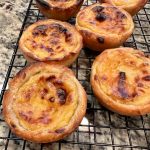
How to Make Pasteis de Nata (+ Happy Birthday to Me!)
How to make pasteis de nata, the famous delicious Portuguese egg custard tart...making homemade pastel de nata is not difficult if you have detailed step-by-step instructions (and I've tested out several techniques to find the best). These delicious custard tarts are perfect for any special occasion!Don't be scared by the length of the steps...I just tried to be super detailed to make it easy for you, and then make sure to reference the photos in the post! Making these homemade pasteis de nata is actually pretty straightforward.
Ingredients
- FOR THE PASTEIS DE NATA DOUGH
- 2 cups minus 2 tablespoons of all-purpose flour plus more for the work surface
- 1/4 teaspoon of sea salt
- 3/4 cup plus 2 tablespoons of ice water
- 2 sticks 8 oz of unsalted butter (room temp & stirred until smooth)
- FOR THE FILLING
- 75 g of granulated
- 34 g of water
- Cinnamon stick optional
- Lemon peel optional
- 18 g of all-purpose flour
- 1/4 teaspoon of salt
- 126 g of full-fat milk
- 80 g of heavy cream
- 3 large egg yolks beaten
- 3/4 teaspoon of vanilla extract
Instructions
- MAKE THE PASTEIS DE NATA DOUGH: In a stand mixer fitted with a dough hook, mix the flour, salt, and water until a soft pillowy dough forms. It should pull away from the side of the bowl after about 30 seconds.
- Generously flour a work surface and pat the dough into a 6-inch (15-cm) square using a pastry scraper. Lightly flour the dough, cover with plastic wrap, and let it rest at room temperature for 15 minutes.
- Roll the dough into an 18-inch (46-cm) square. As you work, use the scraper tool to lift the dough so the underside isn't sticking to your work surface.
- Brush the excess flour off the top of the dough, trim any uneven edges, and (using a small offset spatula), dot and then thinly spread the left two-thirds of the dough square with a little less than one-third (1/3) of the butter, leaving a 1-inch (25 mm) plain border around the edge of the dough.
- Neatly fold the unbuttered right-hand third of the dough (using the pastry scraper to loosen it if it sticks) over (it will cover half of the buttered part).
- Brush off any excess flour, then fold over the left-hand (buttered) third of the dough.
- Starting from the top, lightly press down the dough with your hand to release any air bubbles, then pinch the edges of the dough to seal it. Brush off any excess flour.
- Turn the dough 90 degrees to the left (clockwise) so the fold is facing you. Lift the dough and lightly flour the work surface.
- Gently roll it out to an 18-inch (46-cm) square again, then dot the left two-thirds of the dough square with 1/3 of the butter and spread it over the dough (again, leaving a 1-inch border). Fold the dough as directed in steps 5 and 6.
- For the last rolling, turn the dough 90 degrees to the left (clockwise) and roll out the dough to an 18-by-21-inch (46-by-53-cm) rectangle, with the shorter side facing you. Spread the remaining (one third of the) butter over the entire surface of the dough.
- Using the scraper as an aid, lift the edge of dough closest to you and tightly roll the dough away from you into a log, brushing the excess flour from the underside as you go.
- Trim the ends and cut the log in half. Wrap each piece in plastic wrap and chill for 2 hours or preferably overnight. (It can be frozen for up to 3 months.)
- MAKE THE CUSTARD FILLING: In a saucepan, heat the water and sugar until it boils, and cook boiling for 3 minutes until it forms a syrup (the temperature should be around 105C or 220F). Discard the cinnamon stick and peels, pour into a bowl, and set aside.
- In a saucepan (you can use the same one), begin warming the milk and cream together gently. In a small bowl, mix the flour with a small amount of the milk together to dissolve it. Once the milk and cream starts to simmer, add the flour/milk mixture and whisk together.
- Heat on medium low until it thickens (the temp should be at 75C-80C, when small bubbles start to form). Remove from heat. Add your syrup to the milk and whisk it in.
- Then you'll want to first add a tiny bit of the hot milk mixture to your beaten eggs and whisk it in, then a little more, then a little more. This is called "tempering", and gently introduces heat to the eggs so they don't become scrambled.
- Finally, add the egg mixture into the milk mixture, whisking vigorously, and whisk in the vanilla as well. Then heat on low until the custard reaches 185C in temperature (it should thicken nicely).
- Remove from heat and run it through a sieve into a bowl. Then do that two more times. YES, somehow the three times through the sieve makes a difference, do it!
- Keep it in the bowl, put plastic wrap on the top (along the surface of the custard so it doesn't get a skin), and then refrigerate until fully chilled 2-3 hours or overnight.
- ASSEMBLE & BAKE THE TARTS: Place an oven rack in the top third position (ideally as close to the broiler/grill as possible). Heat the oven to 550°F (290°C).
- Remove one of the pastry logs from the refrigerator and gently roll it back and forth on a lightly floured surface to lengthen it until it's about an inch (25 mm) in diameter and 16 inches (41 cm) long. Cut it into scant 3/4-inch (18-mm) pieces.
- Place one piece of pastry dough, cut side down, in each well of a 12-cup mini-muffin pan (or the traditional pasteis de nata molds, in which case use a generous 1 inch piece). Allow the dough pieces to soften for several minutes until pliable.
- Have a small cup of water nearby. Dip your thumbs in the water, then press straight down into the middle of the dough spiral. Flatten it against the bottom of the cup to a thickness of about 1/16 inch (1.5 mm), then smooth the dough up the sides in a spiral to create a raised lip about 1/8 inch (3 mm) above the pan. The pastry bottoms should be thinner than the tops.
- Fill each cup about 75-80% full with the cooled custard (the filling puffs as it bakes). The filling was thick, so I used a tiny ice cream scoop.
- Bake the pastries until the edges of the dough are frilled and brown, about 6 to 8 minutes and then another 4 minutes switched to broil if using the mini-muffin tins. Double that for the classic Portuguese custart tart tins, about 12 to 17 minutes and then still just about 4 minutes under the broiler.
- Remove from the oven and allow the tarts to cool a few minutes in the pan, then use tongs to transfer to a rack and cool until just warm. Sprinkle the pasteis generously with cinnamon and serve. Repeat the baking with the remaining pastry and custard. These are best consumed the day they're made.
Notes
- Don’t be tempted to reduce the sugar content in the filling. It helps stabilize the custard and allows it to withstand the crazy high temperature, keeping it silky smooth and stops it from splitting.
- Yes, that oven temp is accurate. Basically, crank it as high as it can go. The burnt tops and charred edges are the hallmark of these tarts, providing some bitterness to counteract the sweet custard. Don’t be afraid to take it right to the edge.
- To get even crispier pastry, pre-heat a baking sheet in the oven and then put the muffin tin on there to bake.