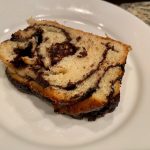
Chocolate Brioche Babka
This chocolate brioche babka is perfect in its simplicity, a marriage of traditional babka with a brioche dough. It's also surprisingly easy, perfect for both new and experienced bakers. The brioche makes it rich and moist, and it has a deep chocolate flavor ribboned throughout.
Servings: 2 loaves
Ingredients
- DOUGH
- 4 1/4 cups 530 grams of all-purpose flour, plus extra for dusting the counter
- 1/2 cup 100 grams of granulated sugar
- 2 teaspoons of instant yeast not active dry
- Grated zest of half an orange
- 3 large eggs I lightly beat them before adding, to more easily incorporate
- 1/2 cup of water cold is fine, & up to 1 to 2 tablespoons extra if needed
- 3/4 teaspoon of fine sea or table salt
- 2/3 cup of unsalted butter 150 grams or 5.3 ounces at room temperature
- Avocado or olive oil for greasing the bowl
- FILLING
- 4 1/2 ounces 130 grams of good dark chocolate (or approximately 3/4 cup of dark chocolate chips)
- 1/2 cup 120 grams of unsalted butter
- Scant 1/2 cup 50 grams of powdered sugar
- 1/3 cup 30 grams of cocoa powder
- Pinch of salt
- 1/4 teaspoon of cinnamon [optional]
- SYRUP FOR GLAZING
- 1/4 cup of water
- 4 tablespoons of granulated sugar
Instructions
- Make the dough: In the bowl of your stand mixer, combine the flour, sugar, and yeast.
- Add the eggs and 1/2 cup of water plus the orange zest, mixing with the dough hook until it comes together; this may take a couple minutes. It’s okay if it’s on the dry side, but if it doesn’t come together at all, add extra water, 1 tablespoon at a time, until the dough forms a mass (it will still be a bit dry, that's okay).
- With the mixer on low, add the salt, then the butter, a spoonful/piece at a time, mixing until each piece is incorporated into the dough before adding the remaining pieces.
- Then, mix on medium speed for 10 minutes, until dough is completely smooth. You'll need to occasionally scrape the sides of the bowl a few times to make sure it gets everything. Generally by the 8-10 minute mark the dough has begun to pull away from the sides of the bowl, which is a good sign. If it doesn’t, you can add 1 tablespoon of extra flour to help this along.
- Coat a large bowl or container with some oil and place dough inside, cover with plastic wrap, and refrigerate. Leave in fridge for at least half a day, preferably overnight. The dough will not fully double, so don’t worry if it still looks a bit small in the morning.
- Make the filling: Melt the butter and chocolate together until smooth. Stir in the powdered sugar, cocoa powder, and salt. Add the cinnamon if desired as well. The mixture should form a spreadable paste. Set aside to cool.
- Assemble loaves: Coat two 9-by-4-inch (2 1/4 or 1kg) loaf pans with oil or butter, and line the bottom of each with a rectangle of parchment paper I make a kind of sling).
- Take half of dough from fridge (leave the other half chilled). Roll out on a lightly-floured counter to about a 10-inch width (the side closest to you) and as long in length (away from you) as you can when rolling it thin (likely 10 to 12 inches).
- Spread half of chocolate mixture evenly over the dough, leaving a 1/2-inch border all around. Brush the end farthest away from you with a bit of water. Roll the dough up (starting with the short end by you), being careful not to squish the filling out. Seal the dampened end onto the log. If your mixture was extra runny, you can put the log in the fridge for 10 minutes.
- Repeat the rolling and filling process with the other half of the dough.
- Trim the last 1/2-inch off each end of the logs. Gently cut each log in half lengthwise and lay them next to each other on the counter, cut sides up. Pinch the top ends gently together. Lift one side over the next, forming a twist and trying to keep the cut sides facing out (because they’re pretty). It doesn't matter if this is a bit messy, it will still turn out lovely.
- Transfer each twist into your prepared loaf pans. Don't worry about gaps, the dough will fill in everything by the time it re-rises and bakes.
- Cover with a damp tea towel or loose plastic wrap and leave to rise for another 1 to 1 1/2 hours at room temperature.
- Bake and finish the loaves: Heat your oven to 375°F (190°C). Uncover the loaves and place both on the middle rack of your oven. Bake for 30 minutes, but start checking for doneness at 25 minutes. A skewer inserted into an underbaked babka will feel stretchy/rubbery inside and may come back with dough on it.
- When fully baked, you’ll feel almost no resistance (and the bread parts should be over 200 F inside). If you babka needs more time, put it back, 5 minutes at a time then re-test. If it browns too quickly, you can cover it with foil.
- While babkas are baking, make the simple syrup. Bring sugar and water to a simmer until sugar dissolves. Remove from heat and set aside to cool somewhat. As soon as the babkas leave the oven, brush the syrup all over each. I usually give it two coats, I don't actually use all the syrup (I think Smitten Kitchen does). Let them cool about halfway in the pan, then transfer to a cooling rack to finish cooling.
- Babkas keep for a few days at room temperature. Any longer and you should freeze them.
Notes
- The original recipe has some additional ingredients (pecans and more granulated sugar) and uses lemon zest instead. Feel free to check it out if that's up your alley.
- Use the highest-quality butter you can, as the butter flavor in a brioche is key.
- Since the dough makes two loaves, you can also make one with the chocolate filling, and then fill the other with whatever flavors/ingredients you want to try.